
• Skip to main content
  • Skip to navigation
  • Accessibility
  • Contact Us
Government of Western Australia Crest
Government of Western Australia
Government of Western Australia Crest

Additional Menu

  • Accessibility
  • Contact us
Go to WA Government search
  • About us
    • Overview
    • Vision and values
    • Our structure
      • Board
      • Executive
      • District Health Advisory Councils
    • Our research
      • Clinical trials
      • Innovation
      • Research
    • Building projects
      • Project - Bunbury Regional Hospital redevelopment
      • Project – Laverton Hospital
      • Project – Tom Price and Paraburdoo Hospitals
      • Project - Geraldton Health Campus
      • Project - Mullewa Community Hospital
      • Completed projects
      • Country health housing
    • Publications
      • Annual reports
      • Strategic plans
      • Health profiles and service plans
      • Policies
    • Contact us
      • Provide feedback
      • Aishwarya’s CARE Call
  • Our services
    • Kimberley
      • Kimberley regional profile
      • Kimberley local health directory
      • Kimberley health services
      • Kimberley contacts
    • Pilbara
      • Pilbara regional profile
      • Pilbara local health directory
      • Pilbara health services
      • Pilbara contacts
    • Midwest
      • Midwest regional profile
      • Midwest local health directory
      • Midwest health services
      • Midwest contacts
    • Goldfields
      • Goldfields regional profile
      • Goldfields local health directory
      • Goldfields health services
      • Goldfields contacts
    • Wheatbelt
      • Wheatbelt regional profile
      • Wheatbelt health services
      • Wheatbelt contacts
    • South West
      • South West regional profile
      • South West local health directory
      • South West health services
      • South West contacts
    • Great Southern
      • Great Southern regional profile
      • Great Southern local health directory
      • Great Southern health services
      • Great Southern contacts
    • Home Hospital
    • Command Centre
      • Acute Patient Transfer Coordination
      • Acute Specialist Telehealth Service
      • Advanced Patient Monitoring System
      • Emergency Telehealth Service
      • Inpatient Telehealth Service
      • Mental Health Emergency Telehealth Service
    • Voluntary assisted dying
  • Our patients
    • Patient Assisted Travel Scheme - PATS
      • About PATS
      • PATS contacts
      • PATS claim forms and information sheets
      • PATS processes explained
      • PATS subsidies
      • PATS eligibility
      • Eligible specialist medical services
      • Frequently asked questions
    • Country PatHS
    • Live Organ Donor Travel and Accommodation Reimbursement Scheme
    • Telehealth
      • Is telehealth suitable for me?
      • Do you already have a telehealth appointment scheduled?
      • Telehealth for non-government organisations and health professionals
      • Telehealth stories
      • Emergency Telehealth Service
      • Telehealth technical support and regional contacts
    • Information for kids and teens
  • Our workforce
    • Work with us
      • Living and working in country WA
      • Medical workforce and education
      • Nursing and midwifery careers
      • Allied health and health science careers
      • Online Contractor Registration and Induction
    • Students
      • Career prospects
      • Work experience
      • University and TAFE study
      • Financial assistance
      • Student health professionals
    • Scholarships and grants
  • News
  1. Home
  2. News
  3. 2025
  4. 12
  5. 23
  6. Country health staff take the stage for Rheumatic Heart Disease

Country health staff take the stage for Rheumatic Heart Disease
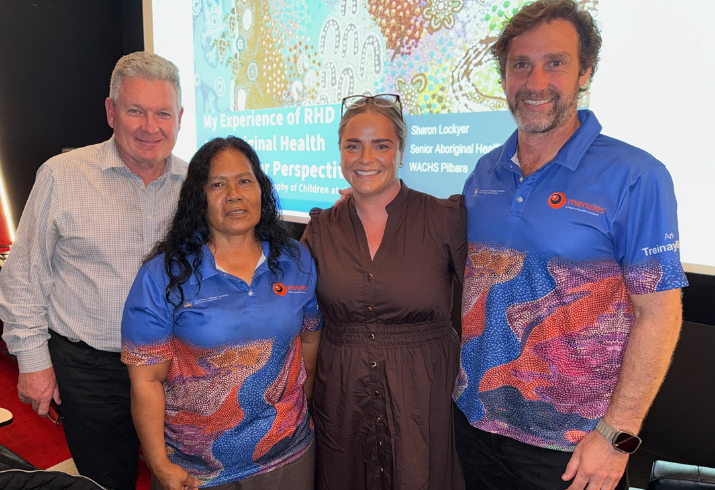
Country health staff take the stage for Rheumatic Heart Disease

23/12/2025

WA Country Health Service’s Sharon Lockyer and Dr James Marangou recently took to the Philips Echo Focus Event stage to give a presentation about the impacts, improvements, and milestones reached in tackling Rheumatic Heart Disease (RHD) in country WA.

RHD is a serious disease caused by bacterial infection. It involves damage to one or more of the four small heart valves and disproportionately affects Aboriginal and Torres Strait Islander people in Western Australia.

The event included a screening of the Take Heart: Deadly Heart documentary, which was filmed in collaboration with WACHS Pilbara staff and local communities, followed by presentations from clinicians and sonographers sharing their insights and experiences in RHD care.

Aboriginal Health Practitioner Sharon Lockyer presented on her own lived experience seeing first-hand the impacts RHD has had on her own family, and how this has informed her passion to deliver and improve RHD care for children in country communities.

She drew from her experience working as a health professional for approximately 14 years and described the valuable work being undertaken in the Pilbara as part of the NEARER SCAN research study (Non-Expert Acquisition and Remote Expert Review of Screening echocardiography images from Child health and AnteNatal).

Partnering with the Menzies School of Health Research, WA Country Health Service has participated in the study since 2023, training local health workers in non-expert echocardiography in the Pilbara.

“I am proud to be one of the first of many trainees for the NEARER SCAN study to assist at-risk families in the early screening and diagnosis for RHD,” Sharon said.

“Through the study, we’ve been able to provide education by showing children and families what their heart looks like on the tablets and it’s really engaging for them.

“Aboriginal people are visual and hands-on learners and it’s important to use tools and resources that help them connect RHD and prevention,” she added.

Consultant Cardiology Physician Dr James Marangou reflected on the discussions had within the Take Heart film – including social impacts and living situations, as well as potential barriers to basic hygiene, which can drive rates of Strep A infections that lead to RHD.

He highlighted that echo screening is one part of the larger picture of RHD care in WA.

“Detecting RHD early (using heart ultrasound) provides the opportunity to start antibiotic treatment that prevents progression to severe disease.

“Through this, we hope to continue raising awareness of RHD and providing education to our communities to reduce and prevent the disease.”

The NEARER SCAN study has trained seven local health professionals, including five Aboriginal health staff, to perform basic echo screening for RHD to country communities.

600 training scans were performed as part of the trainee assessment phase and, to date, seven participants have been enrolled in the study.

In 2023, a community screening event was held in Jigalong with 119 community members screened.

In 2026, the study will look to evolve into the next stage, which will involve opportunities to expand participation, training, access, and study sites, including working closely with local Aboriginal Community Controlled Health services, schools, and community leaders.

Last Updated: 23/12/2025
  • Facebook
  • LinkedIn
  • YouTube

Footer menu

  • wa.gov.au
  • Copyright
  • Disclaimer
  • Privacy
  • Sitemap
  • Contact Us

Brought to you by the Department of Health, Western Australia

© Government of Western Australia 2018 to