

Showcasing innovation at the Aboriginal Health Conference 2026
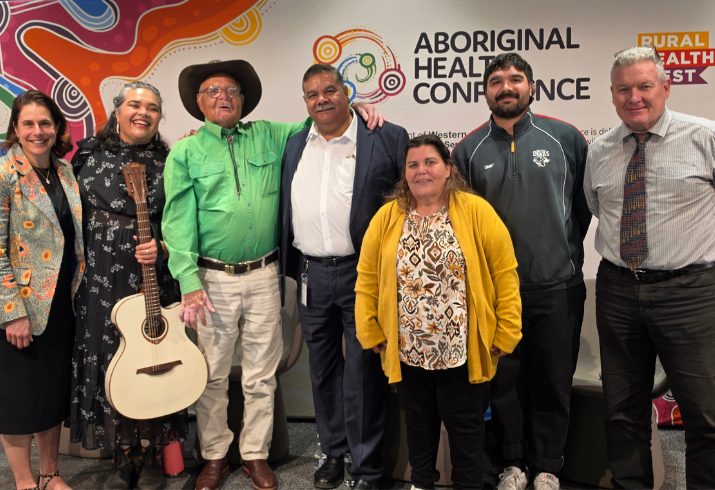 (L-R) Catherine Elliott, Rosie Sitorus, Peter Salmon, Russell Simpson, Vickie Baumgarten, Mitchell Merritt and Jeff Moffet.
Close to 300 healthcare professionals, Aboriginal health workers, Aboriginal Elders, leaders, and community members, researchers, students, and members of the wider country WA community, came together recently for the Aboriginal Health Conference 2026.
Hosted by WA Country Health Service in partnership with Rural Health West, the conference is an important opportunity to share knowledge, strengthen culturally safe, respectful and responsive healthcare, foster collaboration, and drive strategies that will help improve health and wellbeing outcomes for Aboriginal people and their communities.
This year’s theme, Healing Ourselves, Healing Country, Healing Community, reflected a deep and enduring truth: healing starts within.
Starting as you mean to continue
Master of Ceremonies Ingrid Ngoorlak Cumming – a respected Whadjuk Ballardong Noongar woman from Fremantle – kicked off proceedings with her passion for change and reconciliation shining through.
Her Elders gave her the name ‘Ngoorlak’, the Noongar name for the Carnaby’s Cockatoo, a bird associated with bringing rain, healing and change – qualities that were reflected in her presence throughout the event.
Noongar Elder from the Whadjuk and Ballardong groups, Robyn Collard delivered a deeply moving Welcome to Country, accompanied by her grandsons Tryse and Leeyo Rioli – who gave powerful digeridoo performances.
WA Country Health Service Chief Executive Jeff Moffet delivered the opening address remarks – which resonated with attendees, including Ingrid, who thanked Jeff and highlighted the important work being done by the health service.
Ingrid made specific mention of the ‘Looks like me, sounds like me’ eating disorder program for Aboriginal young people, the organisation’s commitment towards programs that help to remove the burden of cultural load, and the work the organisation is doing in the preventative health space.
Connection, culture and storytelling through song
Keynote speakers Ngaliju ('us two') – a cross-cultural collaboration between Thiinma Elder Peter Salmon, from the Upper Gascoyne and Rosie Sitorus, a Midwest-based musician and linguist – set the tone for the conference.
Joined by members of Peter’s family, Ngaliju honours shared experiences and the power of coming together, using song to strengthen relationships, celebrate culture, and connect people across generations.
Their performance was both uplifting and meaningful, and left attendees with an appreciation for Aboriginal storytelling and the important role it plays in educating, inspiring and bringing people together.
Our workforce leading the way
Further to Ingrid’s comment, WA Country Health Service was well represented at the conference – with more than 80 staff members attending and four sessions presented.
|
Senior Project Officer - Eating Disorders – Aboriginal Mental Health Lisa Collard Clinical Psychologist – Eating Disorders Bronwyn Raykos
Looks like me, sounds like me: Co-designing a culturally grounded screening tool for eating disorder risk in Aboriginal young people (12–24 years)
This presentation shared the co-design journey of a culturally grounded screening tool developed in partnership with Aboriginal communities across regional and remote Western Australia.
Drawing on extensive consultation and collaboration with young people, clinicians and Aboriginal health leaders, the project responds to a clear national gap in early identification and support. |
|
Aboriginal Liaison Officer – South Hedland Warren Ingie Nurse Practitioner – Nephrology – Karratha Sonia Mupotaringa Acting Clinical Nurse Consultant – Renal Cherifer Samante
Stronger on Country: Transforming Kidney Care in Remote Pilbara Communities
In 2025, WA Country Health Service launched the State’s first dedicated Specialist Chronic Kidney Disease (CKD) Nurse Practitioner (NP) service – a landmark model of care.
Based in the West Pilbara, this pioneering NP-led initiative delivers comprehensive, culturally safe CKD assessment, risk reduction, diagnostics, medication optimisation, and longitudinal management directly On Country through regular outreach clinics and telehealth. |
|
Clinical Nurse – Research Kerry Harker Credential Diabetes Educator – Registered Nurse Claire Groves
The Flash GM trial in the Great Southern; partnering with Aboriginal patients to access technology to improve outcomes in Type 2 diabetes
This presentation shared the story of the FLASH GM Trial, reflecting on the experiences of Associate Investigators working with Aboriginal communities and the participants who used flash glucose monitoring to help manage type 2 diabetes.
The insights showed how the trial impacted people in real life, beyond the results, and explored what it could mean for future diabetes care and research. |
|
Intern Dr Ruby Wallace Held in partnership with LungSmart staff, Emily Guyton, Sam Wallace and Michelle Buck
LungSmart Wet Cough Program
This interactive session aimed to increase awareness and improve early identification and management of respiratory illness particularly in Aboriginal children living in regional Western Australia, helping to reduce the risk of long-term conditions such as bronchiectasis. |
Where we go from here – continuing to build
Feedback during the conference was overwhelmingly positive, with attendees commenting that the presentations were not only relevant, but motivational, the stall holders were engaging and knowledgeable and the atmosphere was one of shared purpose.
Director Aboriginal Health Strategy Russell Simpson said it was important to continue to build on the success of this year’s conference.
“We have seen attendance numbers at the Aboriginal Health Conference continue to climb each year,” Russell said.
“This year’s record numbers demonstrate a collective commitment and understanding across the healthcare sector that better health and wellbeing outcomes for Aboriginal people and their communities require ongoing partnership, learning and action.
“By establishing and growing events such as this, we are investing in a future where Aboriginal children and young people are given the sturdy foundation they deserve, which will enable them grow into healthy adults who are encouraged and helped to succeed.”
This sentiment was echoed by Child and Adolescent Health Service Director Aboriginal Health Mel Robinson, who encouraged health professionals from across Western Australia to take part in the conference.
“Aboriginal health is everyone’s responsibility, and opportunities like this conference allow us to strengthen that commitment together.”
“Whether you work in the city, regional centres or remote communities, there is value in hearing different perspectives and sharing experiences.
“Working together across services and locations is an important part of improving outcomes for Aboriginal people.”
Trigger warning: The next segment of this article discusses suicide.
Visibility. Inclusivity. Safety. Allyship.
The event was closed with a powerful and poignant presentation by Keynote speaker, respected Noongar woman, with ties to the Ballardong, Whadjuk and Yamatji Nations, Brooke Blurton.
Brooke, who is also a member of the LGBTQIA+SB community, shared her story of humble beginnings, and the heartbreaking tragedy of losing her grandmother to a stroke and her mother to suicide in the space of just two weeks; the trauma of which took her voice for two years.
After retreating to the safety of silence, Brooke emphasised that it was the adults around her, who not only showed up, but showed up consistently, together with her own resilience that helped her take back her voice.
It’s a voice she now uses to amplify Aboriginal peoples’, women’s and LGBTQIA+SB community member’s voices, and – particularly in her work as a youth worker – the voices of children and young people.
A woman who is now unapologetically her authentic self, Brooke left attendees with an important message.
As adults, we must provide children and young people with visibility, inclusivity, safety and allyship.
Whether Aboriginal, neurodivergent, part of the LGBTQIA+SB community, from culturally and linguistically diverse backgrounds, part of the people with disability community, or those who identify with one or more of these communities, they must feel seen, heard, included, safe and supported.
We would like to thank everyone who attended, presented and volunteered to make the event such a success and extend our thanks to Rural Health West Chief Executive Officer Professor Catherine Elliott and Rural Health West events and communication staff.